Abbotsford Studio
“Abbotsford”, Woodhouse Hill, nr Lyme Regis, Dorset 1984 – 1988
Abbotsford was situated in the hilly countryside near Lyme Regis, with spectacular sea views. It consisted of two houses side by side, and a cottage. There was a big two storey garage where Alan housed a large gas kiln and three workshops. It took months to get free from the decommissioning of Marnhull, and to get fully installed at Abbotsford.
Alan was now working on his own again, but this was still a productive time. Many smaller hand-built porcelain and stoneware forms were produced including seedcases, eroded and encrusted pebbles, pierced crescent forms, ovals, pierced spheres, urchins, shell forms and pinch pots. Alan received a commission for two giant pierced sphere light features from a private buyer in Edinburgh, which Alan was to build from four hemispheres, but they proved to be very troublesome. One of the halves broke. The buyer settled for hemispheric lightshades and Alan’s family have the other surviving half.
The pots were sold direct from the studio and from the ‘Potters Shop’ in Lyme Regis, run by John Warren and later taken over by Alan’s friends, fellow potter Berey Pealing and his wife Mary. Sales were also made from the Devon Guild Shop and a few other galleries across the West Country.
For a time, the majority of the pots were cracking during firing, a costly period which only came to an end when Alan realised that the clay he had used for years was crudely blended and on this occasion he “had been lumbered with a dodgy batch ”.
Alan decided to go out in a boat with Berey Pealing and drop some of the ruined pots into the sea around Lyme Regis. Alan was amused by the possibility that if anyone should find them, they might be confused as to just what they were? Shortly after this escapade, Wallwork realised that he was being watched by the Police and deduced that they must have thought he had been drug smuggling. Alan did have the last laugh when a piece was netted by a local fisherman and ended up in the local Maritime Museum, described as of ‘unknown origin’.
Abbotsford had unsatisfactory aspects for Wallwork, who had long coveted the ramshackle, and somewhat neglected house that he could see on the hilltop opposite called Whitty Down Farm. When the farmhouse became available, Alan immediately put Abbotsford up for sale and eventually he managed to purchase the property.


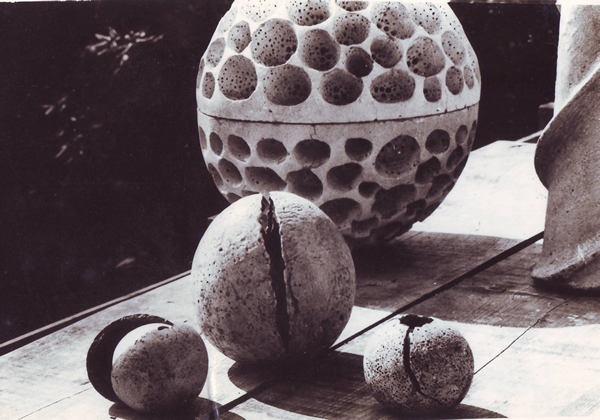
Here follows a selection of work produced at the Abbotsford Studios
Encrusted Pebble Form
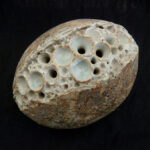
Ring Dot Grooved Oval

Shell Form

Encrusted Pebble Form

Pierced Cleft Sphere

Pierced Opening Form

Segmented Seedcase

Indented Oval

Pierced Crescent

Encrusted Pebble

Grooved Oval

Torn and Grooved 'Ring Dot' Ovals
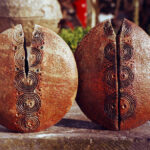
Encrusted Pebble Form

Indented Oval Form

Opening Form

Split Boulder Form
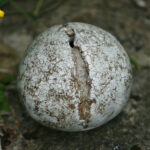
'Torn' Oval Form

Seedcase Cluster

'Snake' Grooved Oval

Eroded Split Boulder Form

Three Leafed Seedcase

Tall Indented Oval Form

Shell Form

Segmented Seedcase

Seedcase Form

Five Leafed Seedcase

Pierced Crescent

Grooved Banded and Pierced Ovals

Small Seedcases

Large Pierced Sphere Light Feature
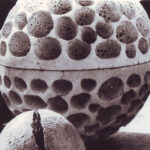
Encrusted Opening Form

Encrusted Pierced Sphere

Segmented Seedcase

Shell Form

Split Oval

Encrusted Pierced Boulder
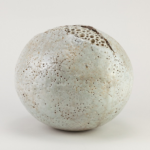
1/2 Pierced Sphere Light Feature
